Roane County Employers Association Workshop - "Substance Abuse: Let Experts Do Their Job (EAPs and Treatment Programs)"
Name:
Roane County Employers Association Workshop - "Substance Abuse: Let Experts Do Their Job (EAPs and Treatment Programs)"
Date:
September 13, 2016
Time:
12:00 PM - 1:00 PM EDT
Registration:
Register Now
Event Description:
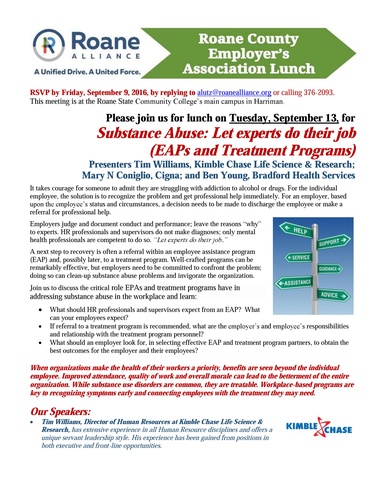
It takes courage for someone to admit they are struggling with addiction to alcohol or drugs. For the individual employee, the solution is to recognize the problem and get professional help immediately. For an employer, based upon the employee’s status and circumstances, a decision needs to be made to discharge the employee or make a referral for professional help.
Employers judge and document conduct and performance; leave the reasons “why” to experts. HR professionals and supervisors do not make diagnoses; only mental health professionals are competent to do so. “Let experts do their job.”
A next step to recovery is often a referral within an employee assistance program (EAP) and, possibly later, to a treatment program. Well-crafted programs can be remarkably effective, but employers need to be committed to confront the problem; doing so can clean-up substance abuse problems and invigorate the organization.
Join us to discuss the critical role EPAs and treatment programs have in addressing substance abuse in the workplace and learn:
Employers judge and document conduct and performance; leave the reasons “why” to experts. HR professionals and supervisors do not make diagnoses; only mental health professionals are competent to do so. “Let experts do their job.”
A next step to recovery is often a referral within an employee assistance program (EAP) and, possibly later, to a treatment program. Well-crafted programs can be remarkably effective, but employers need to be committed to confront the problem; doing so can clean-up substance abuse problems and invigorate the organization.
Join us to discuss the critical role EPAs and treatment programs have in addressing substance abuse in the workplace and learn:
- What should HR professionals and supervisors expect from an EAP? What can your employees expect?
- If referral to a treatment program is recommended, what are the employer’s and employee’s responsibilities and relationship with the treatment program personnel?
- What should an employer look for, in selecting effective EAP and treatment program partners, to obtain the best outcomes for the employer and their employees?
Speakers:
- Tim Williams, Director of HR at Kimble ChaseLife & Science Research
- Mary N. Coniglio, Cigna
- Ben Young, Community Representative for Branford Health Services
Lunch is provided to members and first time guests of non-member organizations. Non-members pay $20 to attend the meeting.
Event Media: